
E♭ Harmonic Minor Scale (Eb, D#)
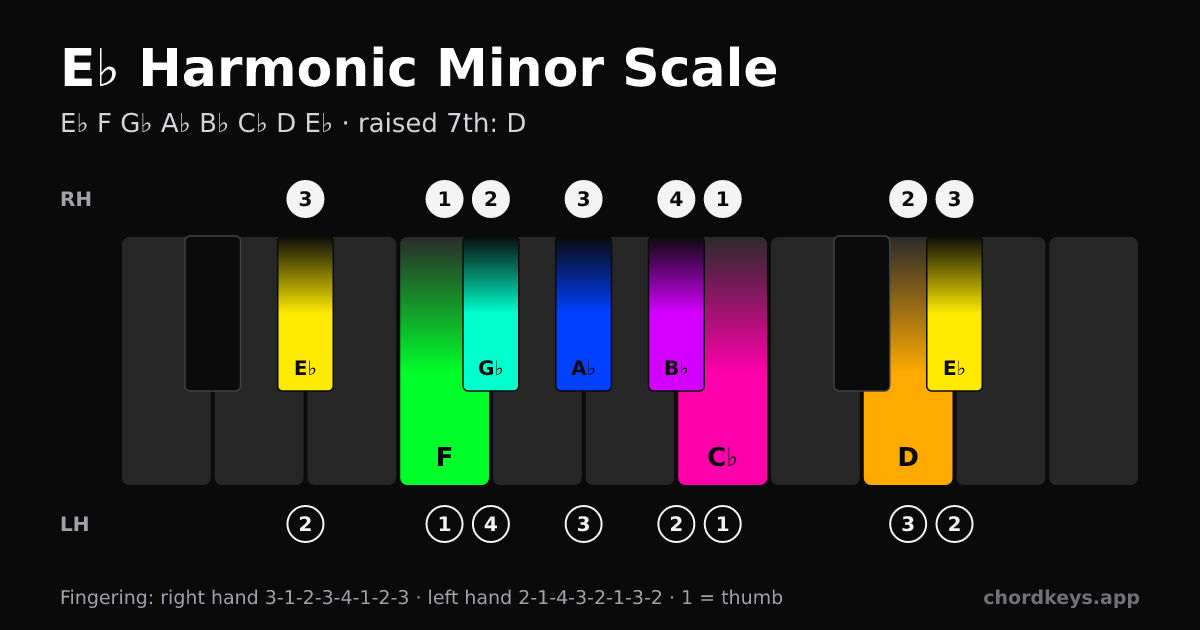
The Eb harmonic minor scale contains Eb – F – Gb – Ab – Bb – Cb – D. It is Eb natural minor with the 7th raised from Db to D. It keeps the key signature of Eb minor (6 flats: Bb, Eb, Ab, Db, Gb and Cb), and the D is written as an accidental. It uses the same piano keys as D# harmonic minor, spelled D# – E# – F# – G# – A# – B – C##.
| Note | Eb | F | Gb | Ab | Bb | Cb | D | Eb |
|---|---|---|---|---|---|---|---|---|
| Right hand | 3 | 1 | 2 | 3 | 4 | 1 | 2 | 3 |
| Left hand | 2 | 1 | 4 | 3 | 2 | 1 | 3 | 2 |
Piano fingering for one octave going up; 1 is the thumb. Coming down, play the same fingers in reverse.
Eb harmonic minor scale fingering
Right hand, going up: the thumb tucks under to F and Cb. Left hand, going up: finger 4 crosses over the thumb to Gb and finger 3 crosses over the thumb to D. Practise each hand alone, slowly, until the turns are smooth, then play hands together.
Eb harmonic minor vs Eb natural minor
| Degree | 1 | 2 | 3 | 4 | 5 | 6 | 7 |
|---|---|---|---|---|---|---|---|
| Natural | Eb | F | Gb | Ab | Bb | Cb | Db |
| Harmonic | Eb | F | Gb | Ab | Bb | Cb | D |
Only the 7th changes. D sits a half step below Eb, so it pulls up to the tonic, which Db does not. It also leaves a gap of three semitones between Cb and D, an augmented 2nd, and that gap is the sound people recognise in this scale.
What Eb harmonic minor is used for
Harmonic minor is what makes a minor key cadence. The raised 7th turns the chord on the 5th degree from minor into major, Bb (Bb D F), and that chord resolves firmly to Ebm. It also gives the diminished Ddim (D F Ab) on the 7th degree. Most minor-key classical harmony borrows these chords, even when the melody stays in natural minor.
Chords that change from natural minor
Notes and intervals
| Note | Degree | Interval from Eb | Semitones |
|---|---|---|---|
| Eb | 1 | root | 0 |
| F | 2 | major 2nd | 2 |
| Gb | b3 | minor 3rd | 3 |
| Ab | 4 | perfect 4th | 5 |
| Bb | 5 | perfect 5th | 7 |
| Cb | b6 | minor 6th | 8 |
| D | 7 | major 7th | 11 |
Step pattern
The harmonic minor scale is built from the pattern W – H – W – W – H – W+H – H (W = whole step, H = half step, W+H = three semitones). Apply that pattern from any starting note and you get the same scale in a different key.
Key signature
Eb minor has 6 flats: Bb, Eb, Ab, Db, Gb and Cb, and harmonic minor uses the same key signature with one accidental, on the raised 7th: D. See the key of Eb minor for the rest of its chords.
Chords in Eb harmonic minor
Stacking thirds on each degree of the scale gives these triads.
| Degree | Numeral | Chord | Notes |
|---|---|---|---|
| 1 | i | Ebm | Eb Gb Bb |
| 2 | ii° | Fdim | F Ab Cb |
| 3 | III+ | Gbaug | Gb Bb D |
| 4 | iv | Abm | Ab Cb Eb |
| 5 | V | Bb | Bb D F |
| 6 | VI | Cb | Cb Eb Gb |
| 7 | vii° | Ddim | D F Ab |
More scales on Eb
Harmonic Minor scale in other keys
Frequently asked questions
What notes are in the Eb harmonic minor scale?
The Eb harmonic minor scale contains Eb, F, Gb, Ab, Bb, Cb, D, then returns to Eb an octave higher.
What is the difference between Eb harmonic minor and Eb natural minor?
Only the 7th note. Eb natural minor has Db; Eb harmonic minor raises it to D, a half step below the tonic.
What key signature does Eb harmonic minor use?
The key signature of Eb minor: 6 flats: Bb, Eb, Ab, Db, Gb and Cb. The raised 7th, D, is written as an accidental.
What is the fingering for the Eb harmonic minor scale on piano?
Going up from Eb to Eb, the right hand plays 3 1 2 3 4 1 2 3 and the left hand plays 2 1 4 3 2 1 3 2, where 1 is the thumb. Coming down, use the same fingers in reverse.
What is the step pattern of the harmonic minor scale?
It follows the pattern W – H – W – W – H – W+H – H, where W is a whole step (two semitones), H is a half step (one semitone) and W+H is three semitones.