
A Harmonic Minor Scale
The A harmonic minor scale contains A – B – C – D – E – F – G#. It is A natural minor with the 7th raised from G to G#. It keeps the key signature of A minor (no sharps or flats), and the G# is written as an accidental.
| Note | A | B | C | D | E | F | G# | A |
|---|---|---|---|---|---|---|---|---|
| Right hand | 1 | 2 | 3 | 1 | 2 | 3 | 4 | 5 |
| Left hand | 5 | 4 | 3 | 2 | 1 | 3 | 2 | 1 |
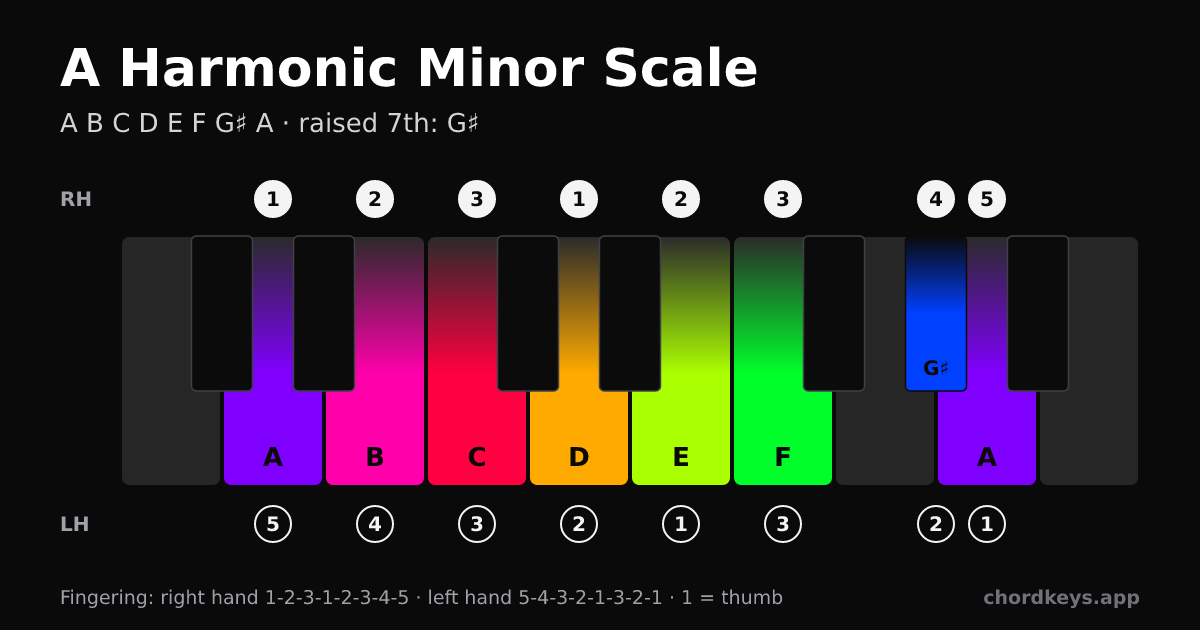
Piano fingering for one octave going up; 1 is the thumb. Coming down, play the same fingers in reverse.
A harmonic minor scale fingering
Right hand, going up: the thumb tucks under to D. Left hand, going up: finger 3 crosses over the thumb to F. Practise each hand alone, slowly, until the turns are smooth, then play hands together.
A harmonic minor vs A natural minor
| Degree | 1 | 2 | 3 | 4 | 5 | 6 | 7 |
|---|---|---|---|---|---|---|---|
| Natural | A | B | C | D | E | F | G |
| Harmonic | A | B | C | D | E | F | G# |
Only the 7th changes. G# sits a half step below A, so it pulls up to the tonic, which G does not. It also leaves a gap of three semitones between F and G#, an augmented 2nd, and that gap is the sound people recognise in this scale.
What A harmonic minor is used for
Harmonic minor is what makes a minor key cadence. The raised 7th turns the chord on the 5th degree from minor into major, E (E G# B), and that chord resolves firmly to Am. It also gives the diminished G#dim (G# B D) on the 7th degree. Most minor-key classical harmony borrows these chords, even when the melody stays in natural minor.
Chords that change from natural minor
Notes and intervals
| Note | Degree | Interval from A | Semitones |
|---|---|---|---|
| A | 1 | root | 0 |
| B | 2 | major 2nd | 2 |
| C | b3 | minor 3rd | 3 |
| D | 4 | perfect 4th | 5 |
| E | 5 | perfect 5th | 7 |
| F | b6 | minor 6th | 8 |
| G# | 7 | major 7th | 11 |
Step pattern
The harmonic minor scale is built from the pattern W – H – W – W – H – W+H – H (W = whole step, H = half step, W+H = three semitones). Apply that pattern from any starting note and you get the same scale in a different key.
Key signature
A minor has no sharps or flats, and harmonic minor uses the same key signature with one accidental, on the raised 7th: G#. See the key of A minor for the rest of its chords.
Chords in A harmonic minor
Stacking thirds on each degree of the scale gives these triads.
| Degree | Numeral | Chord | Notes |
|---|---|---|---|
| 1 | i | Am | A C E |
| 2 | ii° | Bdim | B D F |
| 3 | III+ | Caug | C E G# |
| 4 | iv | Dm | D F A |
| 5 | V | E | E G# B |
| 6 | VI | F | F A C |
| 7 | vii° | G#dim | G# B D |
More scales on A
Harmonic Minor scale in other keys
Frequently asked questions
What notes are in the A harmonic minor scale?
The A harmonic minor scale contains A, B, C, D, E, F, G#, then returns to A an octave higher.
What is the difference between A harmonic minor and A natural minor?
Only the 7th note. A natural minor has G; A harmonic minor raises it to G#, a half step below the tonic.
What key signature does A harmonic minor use?
The key signature of A minor: no sharps or flats. The raised 7th, G#, is written as an accidental.
What is the fingering for the A harmonic minor scale on piano?
Going up from A to A, the right hand plays 1 2 3 1 2 3 4 5 and the left hand plays 5 4 3 2 1 3 2 1, where 1 is the thumb. Coming down, use the same fingers in reverse.
What is the step pattern of the harmonic minor scale?
It follows the pattern W – H – W – W – H – W+H – H, where W is a whole step (two semitones), H is a half step (one semitone) and W+H is three semitones.