
C♯ Melodic Minor Scale (C#)
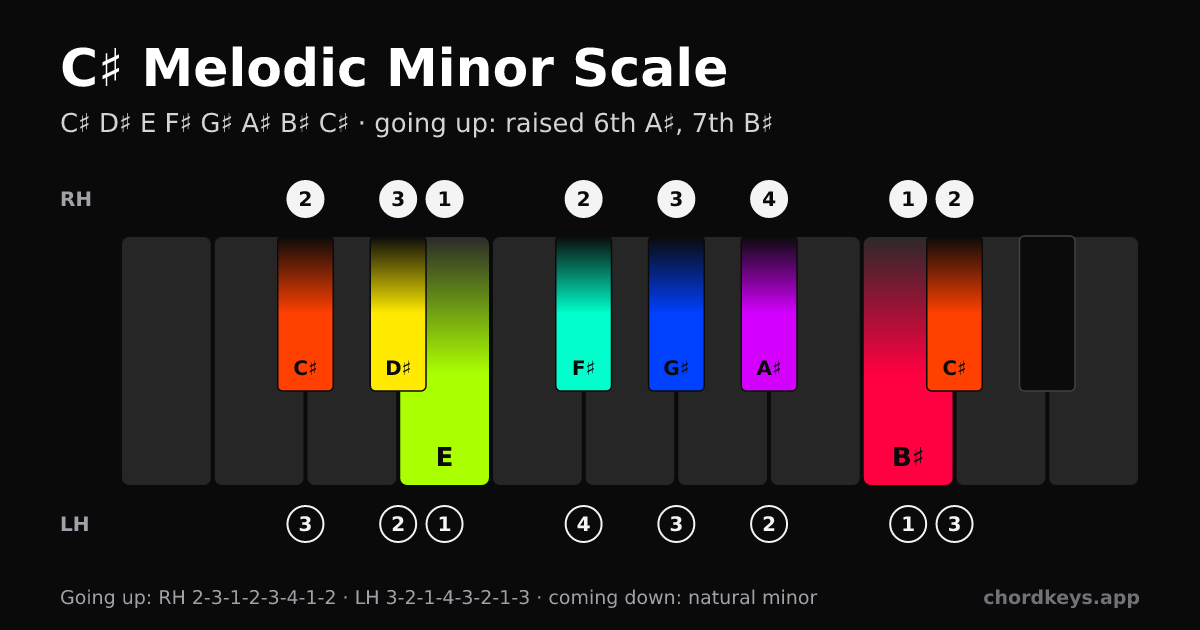
The C# melodic minor scale goes up as C# – D# – E – F# – G# – A# – B# – C#. Coming down it is C# natural minor: C# – B – A – G# – F# – E – D# – C#. The 6th and 7th are raised going up (A to A#, B to B#) and restored coming down, all written as accidentals in the key signature of C# minor (4 sharps: F#, C#, G# and D#).
| Up | C# | D# | E | F# | G# | A# | B# | C# |
|---|---|---|---|---|---|---|---|---|
| Right hand | 2 | 3 | 1 | 2 | 3 | 4 | 1 | 2 |
| Left hand | 3 | 2 | 1 | 4 | 3 | 2 | 1 | 3 |
| Down | C# | B | A | G# | F# | E | D# | C# |
|---|---|---|---|---|---|---|---|---|
| Right hand | 3 | 2 | 1 | 3 | 2 | 1 | 4 | 3 |
| Left hand | 3 | 1 | 2 | 3 | 4 | 1 | 2 | 3 |
Piano fingering for one octave, read left to right as you play it; 1 is the thumb. Coming down the notes are the natural minor's, so the fingers are too.
C# melodic minor scale fingering
Right hand, going up: the thumb tucks under to E and B#. Left hand, going up: finger 4 crosses over the thumb to F# and finger 3 crosses over the thumb to C#. Coming down, the right thumb plays E and A and the left thumb plays E and B. Practise each hand alone, slowly, until the turns are smooth, then play hands together.
Going up vs coming down
| Degree | 1 | 2 | 3 | 4 | 5 | 6 | 7 |
|---|---|---|---|---|---|---|---|
| Up | C# | D# | E | F# | G# | A# | B# |
| Down | C# | D# | E | F# | G# | A | B |
The first five notes never change. Going up, A# and B# lead smoothly to C# and avoid the three-semitone gap of C# harmonic minor. Coming down there is no leading note to serve, so the scale falls back to B and A, the notes of C# natural minor.
What C# melodic minor is used for
In classical music it shapes melodies: a line rising to C# takes A# and B#, and a line falling from it takes B and A. In jazz the ascending notes are played in both directions, and it is often called the jazz minor scale, used over tonic minor chords such as C#m and C#m6.
Chords that change from natural minor
| Degree | Natural minor | Melodic Minor |
|---|---|---|
| 2 | D#dim (ii°) | D#m (ii) |
| 3 | E (III) | Eaug (III+) |
| 4 | F#m (iv) | F# (IV) |
| 5 | G#m (v) | G# (V) |
| 6 | A (VI) | A#dim (vi°) |
| 7 | B (VII) | B#dim (vii°) |
Notes and intervals
| Note | Degree | Interval from C# | Semitones |
|---|---|---|---|
| C# | 1 | root | 0 |
| D# | 2 | major 2nd | 2 |
| E | b3 | minor 3rd | 3 |
| F# | 4 | perfect 4th | 5 |
| G# | 5 | perfect 5th | 7 |
| A# | 6 | major 6th | 9 |
| B# | 7 | major 7th | 11 |
Step pattern
Going up, the melodic minor scale is built from the pattern W – H – W – W – W – W – H (W = whole step, H = half step). Apply that pattern from any starting note and you get the same scale in a different key.
Key signature
C# minor has 4 sharps: F#, C#, G# and D#, and melodic minor uses the same key signature. Going up, A# and B# are written as accidentals; coming down they are cancelled. See the key of C# minor for its chords.
Chords in C# melodic minor, going up
These triads are stacked from the ascending notes, which is how jazz harmony uses the scale. Coming down, the chords are those of C# minor.
| Degree | Numeral | Chord | Notes |
|---|---|---|---|
| 1 | i | C#m | C# E G# |
| 2 | ii | D#m | D# F# A# |
| 3 | III+ | Eaug | E G# B# |
| 4 | IV | F# | F# A# C# |
| 5 | V | G# | G# B# D# |
| 6 | vi° | A#dim | A# C# E |
| 7 | vii° | B#dim | B# D# F# |
More scales on C#
Melodic Minor scale in other keys
Frequently asked questions
What notes are in the C# melodic minor scale?
The C# melodic minor scale contains C#, D#, E, F#, G#, A#, B#, then returns to C# an octave higher. That is the ascending form; coming down it plays C#, B, A, G#, F#, E, D#, C#.
Is C# melodic minor the same going up and coming down?
No. Going up it plays C#, D#, E, F#, G#, A#, B#. Coming down it plays the natural minor: C#, B, A, G#, F#, E, D#, C#. Only the 6th and 7th differ. Jazz players often use the ascending notes both ways.
What key signature does C# melodic minor use?
The key signature of C# minor: 4 sharps: F#, C#, G# and D#. The raised 6th and 7th are written as accidentals.
What is the fingering for the C# melodic minor scale on piano?
Going up, the right hand plays 2 3 1 2 3 4 1 2 and the left hand plays 3 2 1 4 3 2 1 3, where 1 is the thumb. Coming down, the notes change, so the fingers come from the natural minor: from the top note the right hand plays 3 2 1 3 2 1 4 3 and the left hand plays 3 1 2 3 4 1 2 3.
What is the step pattern of the melodic minor scale?
It follows the pattern W – H – W – W – W – W – H, where W is a whole step (two semitones), H is a half step (one semitone) and W+H is three semitones.