
A Melodic Minor Scale
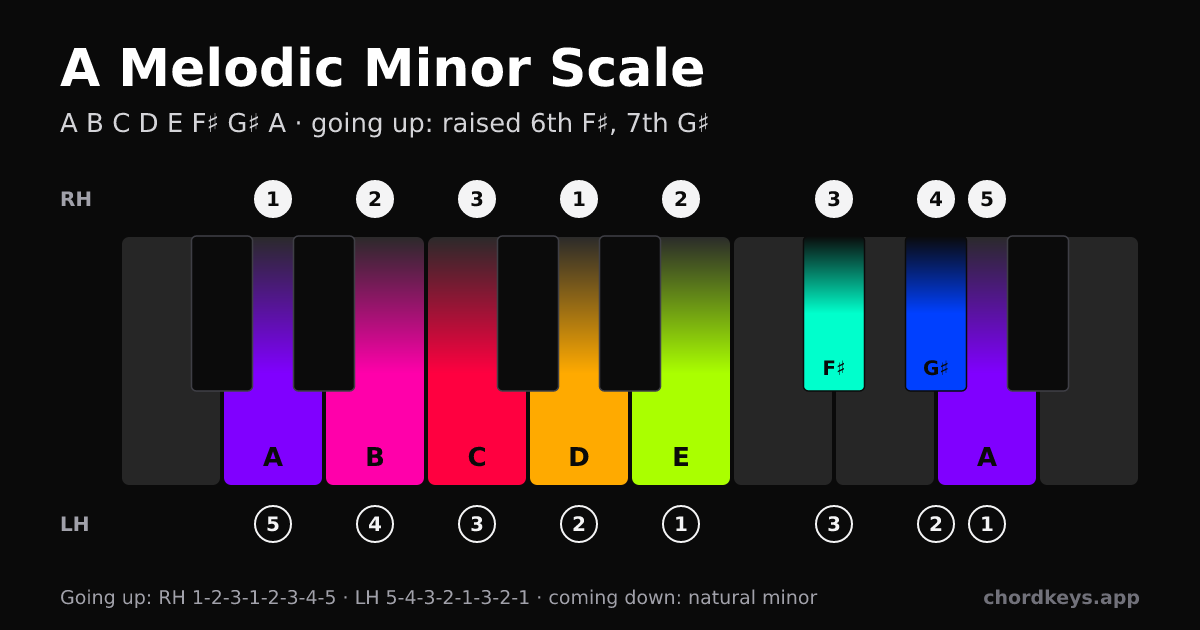
The A melodic minor scale goes up as A – B – C – D – E – F# – G# – A. Coming down it is A natural minor: A – G – F – E – D – C – B – A. The 6th and 7th are raised going up (F to F#, G to G#) and restored coming down, all written as accidentals in the key signature of A minor (no sharps or flats).
| Up | A | B | C | D | E | F# | G# | A |
|---|---|---|---|---|---|---|---|---|
| Right hand | 1 | 2 | 3 | 1 | 2 | 3 | 4 | 5 |
| Left hand | 5 | 4 | 3 | 2 | 1 | 3 | 2 | 1 |
| Down | A | G | F | E | D | C | B | A |
|---|---|---|---|---|---|---|---|---|
| Right hand | 5 | 4 | 3 | 2 | 1 | 3 | 2 | 1 |
| Left hand | 1 | 2 | 3 | 1 | 2 | 3 | 4 | 5 |
Piano fingering for one octave, read left to right as you play it; 1 is the thumb. Coming down the notes are the natural minor's, so the fingers are too.
A melodic minor scale fingering
Right hand, going up: the thumb tucks under to D. Left hand, going up: finger 3 crosses over the thumb to F#. Coming down, the right thumb plays D and the left thumb plays E and A. Practise each hand alone, slowly, until the turns are smooth, then play hands together.
Going up vs coming down
| Degree | 1 | 2 | 3 | 4 | 5 | 6 | 7 |
|---|---|---|---|---|---|---|---|
| Up | A | B | C | D | E | F# | G# |
| Down | A | B | C | D | E | F | G |
The first five notes never change. Going up, F# and G# lead smoothly to A and avoid the three-semitone gap of A harmonic minor. Coming down there is no leading note to serve, so the scale falls back to G and F, the notes of A natural minor.
What A melodic minor is used for
In classical music it shapes melodies: a line rising to A takes F# and G#, and a line falling from it takes G and F. In jazz the ascending notes are played in both directions, and it is often called the jazz minor scale, used over tonic minor chords such as Am and Am6.
Chords that change from natural minor
| Degree | Natural minor | Melodic Minor |
|---|---|---|
| 2 | Bdim (ii°) | Bm (ii) |
| 3 | C (III) | Caug (III+) |
| 4 | Dm (iv) | D (IV) |
| 5 | Em (v) | E (V) |
| 6 | F (VI) | F#dim (vi°) |
| 7 | G (VII) | G#dim (vii°) |
Notes and intervals
| Note | Degree | Interval from A | Semitones |
|---|---|---|---|
| A | 1 | root | 0 |
| B | 2 | major 2nd | 2 |
| C | b3 | minor 3rd | 3 |
| D | 4 | perfect 4th | 5 |
| E | 5 | perfect 5th | 7 |
| F# | 6 | major 6th | 9 |
| G# | 7 | major 7th | 11 |
Step pattern
Going up, the melodic minor scale is built from the pattern W – H – W – W – W – W – H (W = whole step, H = half step). Apply that pattern from any starting note and you get the same scale in a different key.
Key signature
A minor has no sharps or flats, and melodic minor uses the same key signature. Going up, F# and G# are written as accidentals; coming down they are cancelled. See the key of A minor for its chords.
Chords in A melodic minor, going up
These triads are stacked from the ascending notes, which is how jazz harmony uses the scale. Coming down, the chords are those of A minor.
| Degree | Numeral | Chord | Notes |
|---|---|---|---|
| 1 | i | Am | A C E |
| 2 | ii | Bm | B D F# |
| 3 | III+ | Caug | C E G# |
| 4 | IV | D | D F# A |
| 5 | V | E | E G# B |
| 6 | vi° | F#dim | F# A C |
| 7 | vii° | G#dim | G# B D |
More scales on A
Melodic Minor scale in other keys
Frequently asked questions
What notes are in the A melodic minor scale?
The A melodic minor scale contains A, B, C, D, E, F#, G#, then returns to A an octave higher. That is the ascending form; coming down it plays A, G, F, E, D, C, B, A.
Is A melodic minor the same going up and coming down?
No. Going up it plays A, B, C, D, E, F#, G#. Coming down it plays the natural minor: A, G, F, E, D, C, B, A. Only the 6th and 7th differ. Jazz players often use the ascending notes both ways.
What key signature does A melodic minor use?
The key signature of A minor: no sharps or flats. The raised 6th and 7th are written as accidentals.
What is the fingering for the A melodic minor scale on piano?
Going up, the right hand plays 1 2 3 1 2 3 4 5 and the left hand plays 5 4 3 2 1 3 2 1, where 1 is the thumb. Coming down, the notes change, so the fingers come from the natural minor: from the top note the right hand plays 5 4 3 2 1 3 2 1 and the left hand plays 1 2 3 1 2 3 4 5.
What is the step pattern of the melodic minor scale?
It follows the pattern W – H – W – W – W – W – H, where W is a whole step (two semitones), H is a half step (one semitone) and W+H is three semitones.