
E Locrian Scale
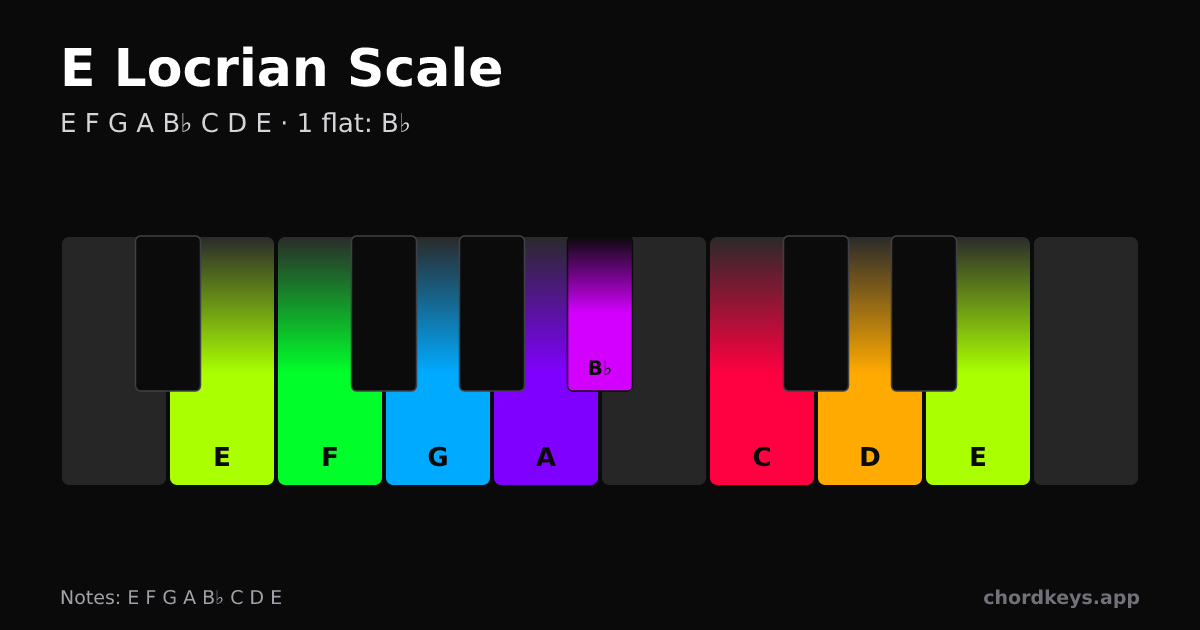
The E Locrian scale contains E – F – G – A – Bb – C – D. It uses 1 flat: Bb.
E Locrian scale chart
Sharps and flats
E Locrian has 1 flat: Bb. Its parent major scale is F major, which uses the same notes. See the chords in the key of F major.
Scale degrees
| Degree | Note | Semitones from E |
|---|---|---|
| 1 | E | 0 |
| b2 | F | 1 |
| b3 | G | 3 |
| 4 | A | 5 |
| b5 | Bb | 6 |
| b6 | C | 8 |
| b7 | D | 10 |
Step pattern
The Locrian scale is built from the pattern H – W – W – H – W – W – W (W = whole step, H = half step). Apply that pattern from any starting note and you get the same mode in a different key.
Chords in E Locrian
Building a triad on each degree of the scale gives you the chords that belong to it. These are the chords to reach for when writing in E Locrian.
Other modes on E
More scales on E
Locrian scale in other keys
Frequently asked questions
What notes are in the E Locrian scale?
The E Locrian scale contains E, F, G, A, Bb, C, D, then returns to E an octave higher.
How many flats are in E Locrian?
E Locrian has 1 flat: Bb.
What is the step pattern of the Locrian scale?
The Locrian scale follows the whole/half step pattern H – W – W – H – W – W – W, where W is a whole step (two semitones) and H is a half step (one semitone).
Which chords work with the E Locrian scale?
The diatonic chords are Edim, F, Gm, Am, Bb, C, Dm. Each is built only from notes of the E Locrian scale, so they all belong to the same tonality — though the diminished chord carries a tritone and normally wants to resolve.